
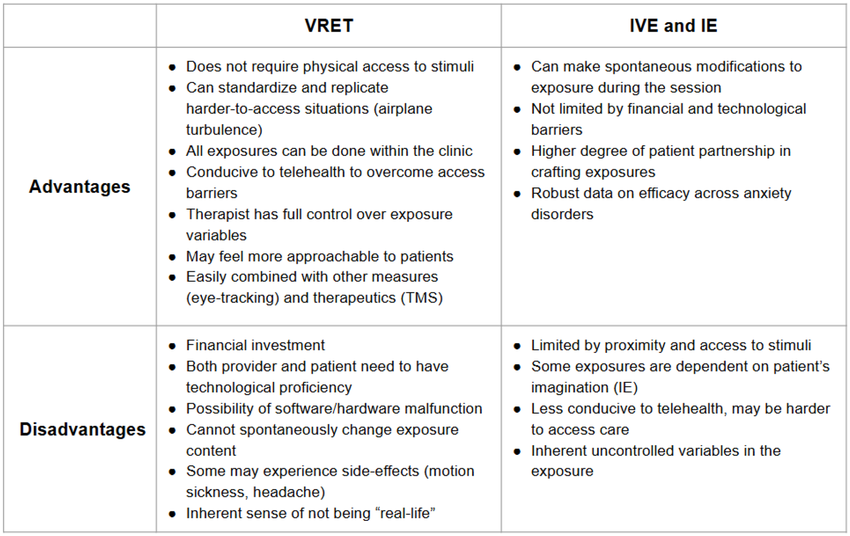
Purpose of Review This review aims to examine the evolving literature on virtual reality (VR) technology in the treatment of anxiety-related disorders. We explore recent evidence across categories of anxiety-related disorders, focusing on the advantages and limitations of VR as a means of delivering exposure therapy. Finally, we propose recommendations for incorporating VR in current clinical practice and areas for future innovation. Recent Findings VR-based exposure therapy (VRET) is the dominant application of VR for anxiety-related disorders. Growing evidence shows that it is a well-accepted intervention that is superior to waitlist conditions, especially for phobias, social anxiety, and post-traumatic stress disorder; however, more investigation is needed into how VRET compares to conventional treatment modalities. Recent innovations include successful self-directed VRET programs, augmenting VRET with neuromodulation, and beginning exploration of therapeutic processes in the delivery of VRET. Notable limitations include limited comparison to standard treatment and lack of standardization of VRET protocol, which limits translatability. VRET shows promise in enhancing treatment models for anxiety-related disorders, but uniformization of software and delivery protocols will be a key next step.
Quelle: